B2B Sales Software: CRM, Business Platform, or ERP?
July 13, 2026 · AmplySales Team
Why does “sales software” mean different things?
Sales software can refer to a point-of-sale system, ecommerce platform, inventory and billing package, CRM, or a salesperson's workspace. Choosing by category label alone is therefore unreliable. Start with the process the software must control.
A B2B sales team usually needs answers to four questions:
- Which companies and people are we working with?
- Which opportunities are active, and where are they in the process?
- What has been agreed with the customer, and what happens next?
- How does a won deal become an order, invoice, or delivered service?
One system may cover several parts, but CRM and ERP are not synonyms.
Four common software categories
| Category | Primary question | Typical data |
|---|---|---|
| CRM | How do we manage customer relationships and opportunities? | accounts, contacts, deals, activities, communication |
| B2B sales software | How do we find, evaluate, and move opportunities toward a sale? | prospects, enrichment, pipeline, proposals, follow-up |
| ERP | How do we manage core operations and resources? | finance, procurement, inventory, production, supply chain |
| Configurable business platform | How do we model our data, permissions, and workflows? | custom objects, fields, relationships, actions, automation |
IBM's ERP overview describes ERP as a way to connect core business processes. Its CRM overview focuses on managing interactions with current and potential customers. Many businesses need both, with controlled data exchange between them.
When is CRM enough?
CRM is the logical center when the primary problem is visibility and discipline in sales:
- company and contact information is scattered;
- opportunities lack a clear stage or owner;
- email and meeting history is not shared;
- follow-up depends on memory;
- management cannot trust the pipeline;
- customer context disappears after the deal closes.
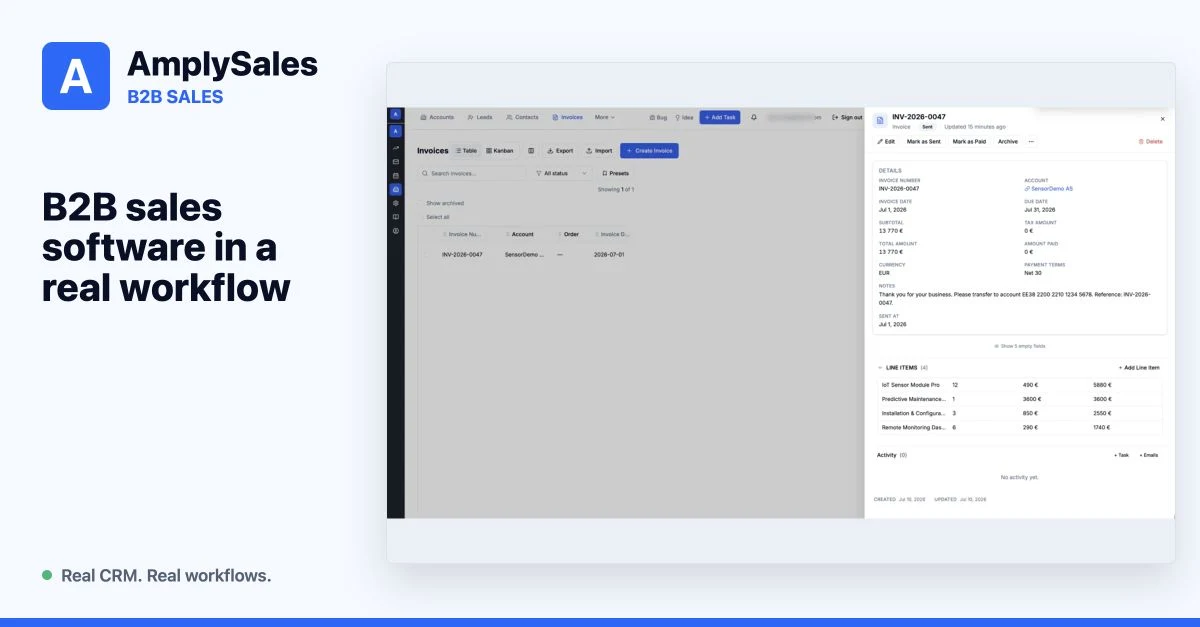
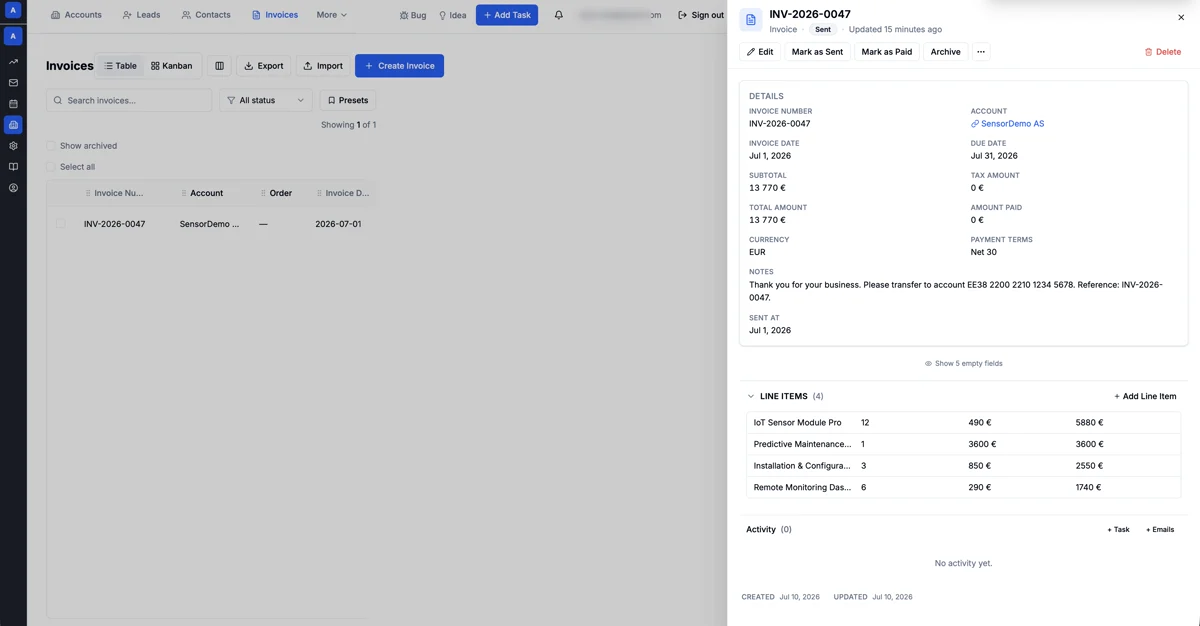
A CRM may contain products, proposals, orders, and invoices. Their presence does not automatically make it an accounting or warehouse system.
When do you need ERP?
ERP becomes important when the business must manage financial and resource processes such as:
- general ledger, tax, and statutory reporting;
- procurement and suppliers;
- inventory, batches, or serial numbers;
- production planning;
- supply chain and logistics;
- workforce or equipment capacity.
If those are the primary buying requirements, CRM marketing should not obscure them. A sound architecture can use CRM for sales and ERP for delivery and finance, connected through clear integrations.
What is a configurable business platform for?
Some processes do not end with a standard contact and deal. A business may need to manage equipment, sites, agreements, inspections, service cases, or partner submissions.
A configurable platform is useful when:
- standard CRM objects cover part of the work;
- the remaining process has its own records and relationships;
- different roles must see different objects or fields;
- actions must run after a record change, schedule, or inbound event;
- the company does not want a new software project for every process.
Flexibility is not free. Someone still has to decide which records and fields are authoritative, who may change them, and how configuration changes are tested.
One B2B workflow across system boundaries
A practical flow might be:
- A prospect is found and enriched in sales software.
- The account, contact, and deal are managed in CRM.
- A proposal uses deal and product data.
- A won deal creates an order or delivery tasks.
- ERP or accounting software issues the statutory invoice and records payment.
- Payment or delivery status returns to the customer workspace.
The goal is not necessarily for one logo to own all six steps. The important things are clear data ownership, handoffs, and error handling.
Where AmplySales fits
AmplySales connects prospect discovery and enrichment, CRM records, email, tasks, pipeline, products, orders, invoices, custom objects, permissions, automation, and AI assistants on one configurable platform.
The boundary matters: AmplySales is not currently a complete accounting, warehouse, or manufacturing ERP. An order or invoice record in CRM supports sales and customer work, but does not automatically replace statutory accounting.
If your problem begins with customer work, start with what CRM is. If standard records are not enough, read about configurable business software.